Showing posts with label Bako-Santubong. Show all posts

Sunday, June 7, 2009

020. The Legend of Princess Santubong (End)

IMG_6848
See that mountain in the yonder? Legend has it that it used to be a Princess before she incurred the wrath of the Heavenly King and was then turned into a mountain. It also tells of a tale of 2 cousins who descended from the pearly gates above to make peace between the neighbouring villages – Pasir Kuning (Yellow Sands) and Pasir Putih (White Sands). Along with this was the rule that they must promise not to quarrel with each other.

So Princess Santubong – famed for her weaving skills, and Princess Sejinjang – master rice thresher, ruled over Pasir Kuning and Pasir Putih respectively. Soon, peace and prosperity proliferated throughout both lands. Besides being experts in their own fields, they were also gorgeous to boot. Every suitor that came left dejected as both princesses, being princesses, were rather hard to please.

But nothing remains bright and sunshine-y forever as dark clouds slowly inched its way through their lives. Their bane and downfall was brought on by their love for the same guy (isn’t that how the story always go, love and war?). And boys being boys, the Crown Prince Serapi of Matang wanted both of them as his wives. Apparently, his love was big enough for both of them. But of course,  that wasn’t the case for both cousins.

And because of him, the cousins fought with each other. The promise which they were entrusted by the Heavenly King shattered at the first exchange of blows. Furious, he turned both princesses into mountains. Indeed, it is said that Mount. Santubong (picture above) resembles a woman lying on her back. But we were lucky that the mountain and her ‘moods’ were fairly sunny during our climb to the summit. The 850m tall summit which we scaled was the second one from the left. 

IMG_7249__IMG_7251
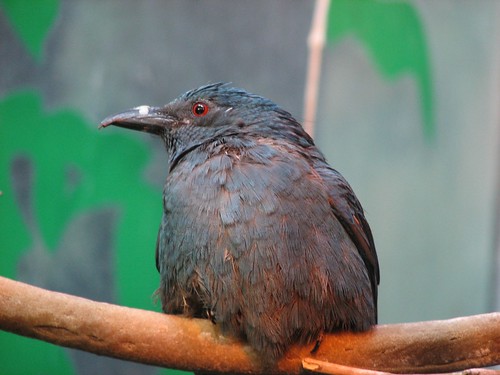
As we trod through the damp pathway that led to our cabin,  rain poured down quite heavily from the skies. And the first creature that greeted us at our lodgings was none other than the gorgeous Asian Fairy Bluebird (Irena puella). Perching on the fronds of the palm, it slowly picked on the abundant, crimson fruits before it took flight (it probably sensed the 4 cameras that were stalking its each and every move.. lol). *This one here is a male; differentiated from the female by the shining, deep-blue on both its upperparts and undertail-coverts.  But like the females, they have red eyes (click on the pictures for a larger image).

imageInterestingly enough, the scientific name of the fairy bluebird seems rather… how would I say.. ermm.. feminine? Well, irena is usually a name bestowed upon girls. In Greek mythology, Irene was one of the the 3 Horae, the personification of peace and wealth. On the other hand, puella is Latin for young girl. Well, it can’t be denied that  the bird is one pretty little thing but I am not sure if the male would care to have his gender disputed by Latin know-its (albeit amateurs). Not as brilliant as the male, the females are described to be more of a dull-turquoise blue.


IMG_7259
After a while, it was the Red-Crowned Barbet’s (Megalaima rafflesii) turn to grace us with his presence. Yes, this one is another male. One reason why males are more brightly-coloured than the females are because she needs more protection. It’s Mother Nature’s way to keep her hidden from her enemies as she has to be tucked safely in the nest to hatch her babies. The other reason is also to attract the female’s attention during the breeding season. And also, it’s supposedly at this time that his colours are the brightest.  As cited, ♥ at first sight indeed!

IMG_7293-1
Prostrating on the ground (in my so-called trademark position.. lol), it wasn’t too long before I managed to snag a picture of the Appias sp. After scanning through many pictures, I have a feeling that this might be a Plain Puffin (Appias indra plana). There aren’t much information about this near snow-white creature except that I am sure it’s from the Family Pieridae.

One important characteristic is that most members of this family are white, yellow or orange in colour besides being often marked by black spots. In fact, the waste products in its body are the source of their unique hues. One butterfly’s crap is another butterfly’s makeup? Anyway, another interesting fact – here’s why butterflies are called butterflies. And no it’s not because someone mistaken for a flying butter for this insect :) , it is believed that the word ‘butterfly’ was inspired from a member of this family –> the Brimstone (Gonepteryx rhamni), which was called the “butter-coloured fly” by early British naturalists [1]. Well, scientists aren’t really famed for their creavity…

IMG_7305__IMG_7311
One other butterfly that I managed to get down in pixels was a Blue Pansy Butterfly (Junonia orithya wallacei) that was helping itself to the nectar of a patch of Coat Buttons (Tridax procumbens). Prettiest of the pansies, its beauty is (again) limited to the males. For the sake of being low-key in the eyes of predators, the females usually have very little or no blue colouring at all. Like the Archduke and Cruiser, this six-legged insect comes from the family Nymphalidae that relies on only 4 legs for locomotion.

IMG_7552__IMG_7554
The butterflies that fluttered and flew weren’t just limited to the ones in open areas (beside the roads on grassy patches), the top of Mount. Santubong was another butterfly haven. Out of the numerous beauties that weaved their way through the paths that were made narrow by the dense vegetation, this sailor was the one and only butterfly that stilled just enough for my camera to get a few shots. The identity of this sailor, unfortunately, cannot be distinguished since yours truly forgot to capture the underside of the creature.. bleh. 

IMG_7371-1
Another insect which managed to make a lasting impact in my mind (and SD card) was the dragonflies and the damselflies. They could be seen hovering still over rain puddles and swampy-like habitats, while others prefer rushing streams and tiny falls like the one (flowing from some source high-up in Santubong) in the picture above.

IMG_7356__IMG_7528
(Left): Seen perching on a lean twig in the rushing river, it seems that this is characteristic of the Euphaea impar. Males, in fact, prefer brightly-lit perches as they are presumed to use those spots to display their wing iridescence to their best advantage. Not only does this attract the ladies, it also serves as a defensive mark of a territory adjacent to moving water [2].

(Right): Though Euphaea sp. might resemble dragonflies, they are actually damselflies. And the way to tell them apart is that the forewing and hindwing of the damsels are similar while these differ for the dragons. I am not sure why a damselfly is called a damselfly but there are some unique tales of the origin of the word ‘dragonfly’.

IMG_7588
So why’s a dragonfly a dragonfly? Though it (the etymology) has not been clearly established, the dragon has long been used in Christian symbolism to reveal the existence of the devil. Hence, it suggests that the origin of the seemingly extraordinary balancing feats of a dragonfly could only be due to satanic influence [3]. Cool eh? But it makes me wonder, if this etymology is indeed true, do people shun streams with this creatures or kill them at first sight? 

Up above in mountains, at 850m from sea level, in a pond on the peak of Santubong was a lone male Brachydiplax chalybea. Well, there might be others but memory only remembers this one.. heheh. Coloured a powder-blue, it is known that the males are strongly territorial and their sexual activity peaks in early afternoon. Ok, I might be right then, there truly only was a single male in the pond ^^v. And because of its metallic blue coloration on its body, this Brachydiplax sp. has ‘made of steel’ for its species name [4]. Sweet~~
1) Greek: brachy “short”
2) Greek: di “double”
3) Greek: plax “flat surface” – probably referring to the wings
4) Latin: chalybea “made of steel”

IMG_7515-1__IMG_7533
Tiny frogs no bigger than the size of palm (length-wise) could be seen on moss-green rocks while others were spotted hopping on the boulders by the waterfall. A vast difference indeed from the ones leading a urban life in the stone jungles.

IMG_7547__IMG_7572
(Left): “I’m on the top of the world lookin’ down on creation, and the only explanation I can find…”
Indeed, from the top of Santubong, the Sarawak River meanders with serpentine grace about the Lego-like houses that flank its sides.

(Right): Framed by verdant view, the South China Sea was a wide expanse from my right onwards. At the background, the cove-like area is actually Bako National Park, where an isolated beach (Teluk Pandan Besar) remains pristine and out-of-reach from a majority of human civilization.

IMG_7581
The song by the Carpenters – Top of the World is a perfect fit of what I feel when I reached the summit of Santubong. Surrounded by greens and browns, the Malaysian flag didn’t look a bit of out of place as it stood high-up against a white cloud-blue sky backdrop. But all that immediately got flushed from the mind as the smell or sulphur swamped my senses as I got closer to the hut. Since many tourists stay overnight after a climb, they usually sprinkle sulphur around the hut to prevent snakes from getting close-by. Sprinkle all you want, but clean up the mess before you leave for goodness sake!!

Apparently, some of these idiots need to relearn their Moral Studies in Year 1. Rubbish could be seen strewn all over beneath the hut. Why, there was even a rusty old kettle (without its handle) by the hut! And the hut, it may look fine from this picture, but it all changes when one takes a closer look. Again, some  thoughtless arses decided that their carvings would make ‘wonderful decorations’ to the rest area. Gosh, these people deserve to have a taste of their own medicine. Who cares what the ang mohs think of Malaysia, what I am ashamed by is the ‘deeds’ left by these so-called ‘wise ones’! Homo barbaricus would be more suitable in this case.

IMG_7603__IMG_7608
Reaching the summit (left) was no easy work as we had to get pass a dozen of so of these rope-ladders (right). There were a couple which dangled nearly three storeys from top to bottom. It makes you wonder how the natives constructed these in the first place. My highest salutations for their work! Without them, Mount. Santubong would still be another alien location on the map. But looking back, would that had been better?

IMG_7617__IMG_7620
(left): After approximately 8 hours on the mountain, catching sight of civilization never seemed so good. Civilization = place to rest my weary, jelly-like legs = time for more Teh C Peng = Sweet!!

(right): On our way down, Alex spotted some physical weathering that had occurred on a boulder, which was otherwise known as exfoliation. Exfoliation occurs when rocks are heated and expand in the heat of the day and then cool and contract in the cold of night. Thin slithers of rock tend to flake off the surface, and which break down further into tiny pieces [5].

IMG_7627
Fare thee well, Princess Santubong and may our paths cross again one day in the future. :)

And finally, a big thanks to Alvin for his help in Birds & Dragonflies 101; Wee Foong for his on the lepidopterans; Kai-Xin for guiding me through the tough-spots on Santubong and last but not least, Alex for extending an invitation to yours truly. Thank you!

P.S: In case you are wondering the Malay poems which I have been posting in the early parts in 3 of my entries, they are actually lyrics to the song ‘Hijau’ by Zainal Abidin. Like Michael Jackson’s ‘Earth Song’, this song is my country’s own wake-up call to protect and conserve nature before we lose it all. Enjoy the clip! :)

Reference:
1. http://en.wikipedia.org/wiki/Pieridae

2. http://rmbr.nus.edu.sg/nis/bulletin2009/2009nis135-140.pdf

3. http://www.sierrapotomac.org/W_Needham/Dragonfly_080514.htm

4. http://www.entsocont.com/JESO/133_3-46.pdf

5. http://www.gcsescience.com/rk8.htm

Friday, May 29, 2009

019. Wagler: Made in China? (Part 3)

Bumi tanpa lautan
Akan kehausan
Pasti lambat laun hilang
Duniaku yang malang

(Hijau, Zainal Abidin, 1998)

Translation:
An Earth that's without seas
Is as good as being thirsty
She will gradually fade away
O’ this poor Earth of mine.

(11th – 18th May 2009)

IMG_7084__IMG_7089
The tree that was situated a few metres in front of our lodgings – Chalet 4, was a hotspot indeed for locals and foreigners alike. It was like, every other minute, there will be groups after groups of tourists who will stay still, look high and low before their cameras went off and flashed like sparklers. Groups usually comprised of at least 2 persons would stop by, whether rain or shine to catch a glimpse of what lies in the cosy verdant niche of stems and plants. So, what caught their attention exactly? 

IMG_6730-1__IMG_6729-1
Presenting the star: the Wagler’s Pit Viper (Tropidolaemus wagleri). According to Wiki, this reptile is a night creature and can be usually found on trees. They might appear quite sluggish as they remain motionless for long periods of time while waiting for dinner to pass by. Hence, Pit vipers are called as such because they have heat-sensing "pits" which occur on each cheek for prey location [1].

And when it does pass by, they can strike doubly quick. In fact, they would strike too if disturbed [2]. But in this case, I beg to differ. It didn’t even blink an eyelid when my camera went as close as 2-3 inches from the snake’s (left) view. Disturbing as it might be, it was rather curious too. Its lethargic movement could certainly give the sloth a run for its money, that’s for certain. Not once did it budge from its comfort zone during the 4 days and 3 nights we were there. This also goes for the juvenile (right) which was placed serpentine high up in the foliage. >_> If not for the tiny flicker of its tongue, the Pit-Viper could have easily passed of as a rubber snake. Seriously.

IMG_7103__IMG_7104
Placed against a sunshine-y backdrop, the fine venation of a Calophyllum sp. leaf is really quite evident. From the Greek kalos “beautiful” and phullon '”leaf”, the plant of the genus literally means “beautiful leaf”. Also known as the Bintangor plant locally, in Borneo, related species of this plant has been found to contain anti-AIDS properties. Of course, further research is being conducted to ascertain the fact.

(left & right): One of the Calophyllum sp. which we bumped into during our walk towards Teluk Pandan Besar – Calophyllum nodosum.

IMG_7147__IMG_7537-1
(left): Another Beauty Leaf which we saw (at the beach area of Teluk Pandan Kecil) is the Calophyllum inophyllum. Because of its decorative leaves, fragrant flowers and spreading crown, it is best known as an ornamental plant [3]. Again, the fragrance is subjective. For me, there wasn’t any distinctive, sweet scent whatsoever (though it can be testified by Alex and Kai-Xin). It’s either my nose was faulty or… my nose was faulty. >_>

(right): A large trunk of the Calophyllum ferrugineum, which we bumped into on our way to the top of Mount Santubong along the 45 degree slope. Its girth was the biggest I have ever laid my eyes on, and I could barely make out the leaves against the glaring skies. The other time I saw one was in Bukit Timah Nature Reserve (Singapore), and the plant was a little, wee thing compared to this giant.

IMG_7111__IMG_7128
(Left): From Telok Pandan Besar, the view of headlands and a sea-swept beach towards my left.

(Right): On towards Telok Pandan Kecil, we continued along the sandy path before coming to the cliff top that overlooks a bay below. 

IMG_7130__IMG_7141
(Left): The sandstone formation on top of the plateau is unique indeed. Here’s Alvin trying to find a good spot to capture a picture of 5.
Note: Just sent an email to my Prof. James Terry on questions pertaining to Bako’s terrestrial geomorphology, such as the one above. Hopefully I will get to hear from him soon. :) Will update if he does *fingers crossed*.

(Right): After a 10-minute descent through cliff vegetation and gnarled roots, we soon reached the beach at the bottom. Caution must be practised here as a slip could caused wounds from gnashes to a swollen ankle. 

IMG_7164__IMG_7180
(Left): The beach, seawards. On the sand, we could see the tiny balls of sand left by Sand Bubblers. Besides that, there were also footprints of the (possibly) Bearded Pig (Sus barbatus). Apparently, the macaques also make the occasional trip down to the area to feed. Macaque motto: Humans = food. 

(Right): The beach that comes up seaward slopes down gently before heading far inland, towards the mangroves and then the forests. A secondary beach maybe?

IMG_7154__IMG_7157
Amongst the balls of Sand Bubbler leftovers were hermit crabs (left) and other species from the Order Decapoda (right). This one took a short break before scuttling into one of the larger holes made by the Sand Bubbler.

IMG_7190-1__IMG_7175
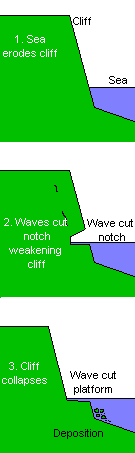
(Left): A close-up of the famous sea stack just offshore of Telok Pandan Kecil Beach. A sea stack is caused by the natural erosion of headlands along the coastline. Typically, the ocean wears a hole through the headlands first, creating an arch which slowly expands over time as it erodes. Ultimately, the arch collapses, leaving a sea stack on one side and the headland on the other. Separated from the shoreline, the sea stack will slowly start to erode, either eroded away into the water or collapsing [4].

(Right): A picture of the wave-cut notch,which is mainly the result of wave erosion and other processes. The undercutting is usually caused between the high and low water marks [5].

IMG_7184 
Dark, ominous clouds sweeping across Santubong, with the sunlight barely shining through.

IMG_7197 
On our way back, rain could be seen falling in sheets on the front half of Santubong. Though it looked like the rain might be advancing towards Bako, it was a clear night on our last day at the National Park.

Looks like Part 4 (end) will be coming up soon enough. :)

Reference:
1. http://www.ecologyasia.com/verts/snakes/waglers_pit_viper.htm

2. http://en.wikipedia.org/wiki/Tropidolaemus_wagleri

3. http://en.wikipedia.org/wiki/Calophyllum_inophyllum

4. http://www.wisegeek.com/what-is-a-sea-stack.htm

5. http://en.wikipedia.org/wiki/Wave-cut_platform

Thursday, May 28, 2009

018. Beauty’s in the Eyes of the Beholder (Part 2)

Bumi yang tiada udara
Bagai tiada nyawa
Pasti hilang suatu hari
Tanpa disedari

(Hijau, Zainal Abidin, 1998)

Translation:
An Earth that's without air
Is as good as being lifeless
She will disappear someday
Without our notice.

(11th – 18th May 2009)

IMG_6945-1
What if you were told that, to reach this waterfall above, you would need to trek continuously for 6 hours? Of course, there’s a chance that you will go hungry and your legs will start to beg for a rest. Just a while, they say. But deep down you know, that once seated and getting your hunger satiated before reaching the falls, the less determined you will be be to reach it. So, what’s the verdict? For us, we started out early at 8:45 in the morning, hoping to reach the Tajor Waterfalls by 12. If not, the latest was estimated to be at 1 noon.

Never did I imagine that the trails (consisting of the Lintang Trail, the Bukit Gondol Trail, the Paya Jelutong Trail, the Bukit Kruning Trail, and the Tajor Trail) would lead us walking till 3 in the afternoon. Thank goodness for the shade and shelter provided by the forest canopy. :) But, whatever aches that I accumulated along the way was swept away once my eyes fell on the flowing white curtain of water that cascaded from the nooks and crannies of the rocks at Tajor. Talk about being therapeutic! 

IMG_6866-1__IMG_6861-1
As usual, we were greeted by the sight of Bearded Pigs (Sus barbatus) as we left our cabin for breakfast early in the morn. These swine (it’s the fad nowadays.. lol) get their name from the yellowish whiskers on the side of the face and over the bridge of the nose; hence their common name.
1) Latin: Sus = "pig"
2) Latin: barbatus = "bearded"

Apparently, the body of this particular pig is the slenderest form among pigs, and it is supported by thin twig of legs.  With their diet comprising of fruits, it’s no wonder that they are often found following groups of gibbons or macaques, then feeding on the fruit that has been gnawed once upon and has then fallen to the ground right after [1]. And it’s true, right on the area (the cabins’ location) where the bearded pigs feasted on, were fruits that fell and got strewn when the macaques high-up shook and rattled the trees after their many bouts of jumping and leaping antics.

Speaking about feeding, this reminds me of a.. how should I say.. unique behaviour of the male Sus. The feeling is subjective, it all depends on how you see it, my friend Mindy would say. =) On our last day of our stay in Bako National Park, we got to see the male pig licking the urine of the female as it gushed like tap water from her ‘watering hole’. After digging a bit, it seems that urine can contain pheromones or chemical substances that change in the course of the oestrus cycle.

Unlike the female human way of dropping subtle hints (batting eyelashes and coquettishness as being noted by some) to entice their male counterparts, this is more like waving a flag with a ‘I’m In Heat’ emblazoned across in hot red. No reading between the lines there. So in order to know the status of females, males will lick the urine of the gentler sex to investigate their oestrous status. In fact, as some of the research conducted on pandas, the males are said to be able to discriminate the female reproductive condition on the basis of the chemical cues [2]. Wonder if this include male Homo sapiens? :)

IMG_6773-1__IMG_6775
(Left):
According to some, it’s said the side view of the Pigeon Orchid flower resembles a flying pigeon. Well, after rotating the picture 180 degrees, it certainly looked somewhat like one, I must say. :) Other common names include the Bag-shaped Dendrobium. This latter would be more accurate, if its specific epithet crumenatum is used as basis. *nods*
1) Latin: crumena (= a leather pouch that held money and was secured by a strap around a Roman's neck)

(Right): When trekking through the Lintang trail, it’s not surprising to catch sight of the Orchid Pigeon (Dendrobium crumenatum) flanking the sides of the white, sandy trails. In Singapore, this orchid is the most common. In fact, it can be found growing naturally in the branches of older trees. Besides that, it’s also planted by the Parks & Recreation Department onto street trees [3]. 

IMG_6886__IMG_6880-1
(Left): Another pretty bloom from the orchid of the genus Dendrobium sp. As described with Latin, the Dendrobium sp. is "one that lives in the trees” or an epiphyte.
1) Greek: dendron “tree”
2) Greek: bios “life”

To differentiate this genus from the rest in the Family Orchidaceae, here are some of the genus characteristics:
(a) Plants may have a group of leaf-bearing axes, which are either (i) cespitose or (ii) at the end on the branches of sympodial ramificant rhizomes.
(b) The leaf-bearing axes may bear from one apical to numerous distichous leaves. The leaves are generally rather thin, but in a few species these are leathery thick and/or laterally compressed.
(c) The inflorescence(s) can be lateral, sub-apical or apical, few to many flowered [4].
Definition:
-> cespitose = growing in dense tufts
->
sympodial = Primary axis that develops from a series of short lateral branches and often has a zigzag/irregular form
-> ramificant = branch-shaped
->
distichous = leaves arranged in two vertical rows on opposite sides of an axis

(Right): Another orchid which colours reminded my friend of the traffic-light popsicle that was found on our way to the falls was the Coelogyne septemcostata. Its generic name Coelogyne is derived from its concave stigma – the part which receives the pollen [5].  And on the same lines, its specific name can be literally translated to “7 ribs”. I am not sure why though. >_<
1) Greek: koilos (coel) “hollow”
2) Greek: gyne “woman”
3) Latin: septem “seven”
4) Latin: costata “with ribs/ribbed”

For the Coelogyne, its distinct genus characteristics include [6]:
(a) Plants may be large and epiphytic
(b) Flowers are often have showy and delicately coloured.
(c) Pseudobulbs are usually ovoid, conical or cylindrical from which 1 or 2 leaves arise at the apex.
(d) Leaves are broad, elliptic and plicate.
Definition:
-> pseudobulb = storage organ (nutrients & water) derived from the part of a stem between 2 leaf nodes
->
apex = tip
-> plicate = folded like a fan

IMG_6810-1 
Looking back at this picture, I am not too fussy that this image of the Bulbophyllum sp. turned out kinda blurred. But it was the best I could do under breezy and lack-of-light conditions. With just one small puff, the stalk that held this bloom swayed back and forth like a compass gone haywire… lol.

One feature of major significance is that the inflorescence (or collection of blooms) always arises from the base of a pseudobulb or from nodes on the rhizome. That means, instead growing from the top of the pseudobulb, it sprouts from underneath like the pretty thing above. :) However, depending on the species, the flowers may/may not be fragrant. In fact, it can even smell downright disgusting [7].

IMG_6882__IMG_6929-1
(Left): As can be seen from this picture of the Bulbophyllum gracillimum orchid, the scientific name – Bulbophyllum sp. is derived from the pseudobulbs on which the leaf is growing [8]. Each pseudobulb bears a solitary, terminal leaf.
1) Latin: bulbus “bulb-like” 
2) Greek: phyllon “leaf”

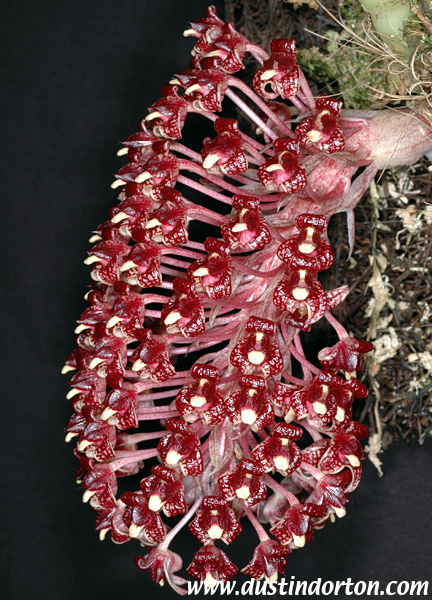
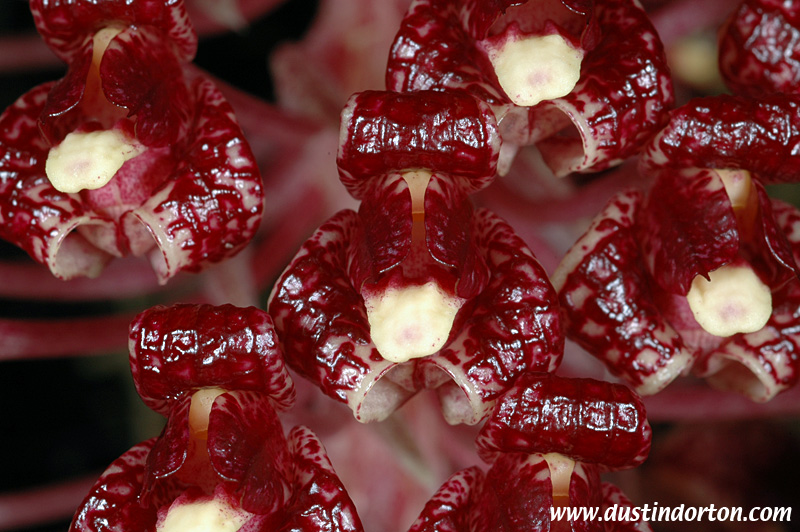
(Right): A rare bulbophyllum from Borneo, the Bulbophyllum beccarii is by far the largest species in its genus. Its huge bowl-shaped leaves are designed to catch falling debris and turn it into fertilizers. The inflorescence is produced from the rhizome near one of the pseudobulbs and hangs downwards to about 20-22cm. Although it is comprised of hundreds of small sweet-looking yellowish flowers netted with red, the blossoms of the B. beccarii is one bulbophyllum that stinks to attract various flies [9].

IMG_7560__IMG_7561
(Left): Other orchids include this Dendrochilum sp. which the guys found growing on top of Mount. Santubong. Noticed the brown protrusions that is attached to every blossom on the dangling stalk? I presumed that’s the lip which led to the derivation of the name of the genus, Dendrochilum sp. But ambiguity still exists in this case. Here’s why [10]:
1) Greek: dendron “tree”
2) Greek: cheilos “lip” @ chilos “green food – possibly, referring to its epiphytic growth”

Some distinctive characteristics of this genus are [11]:
(a) The plants can be either epiphytic or lithophytic (plant growing on stone).
(b) The flowers are mostly very small but are produced in considerable numbers in long, dense, often distinctly two-ranked racemes.
Definition:
-> raceme = an inflorescence having stalked flowers arranged singly along an elongated unbranched axis

IMG_6867-1__IMG_6874
Outcrops of sandstone wall face were rather abundant when we walked through the 1st hour via Lintang trail. With staircases and painted signs to guide us through the uneven surfaces and our way, the journey was pretty much a walk in the park compared to Santubong. This does not include the one time we had to inch our way through a foot-wide ledge in order to continue on on the (at least) 13km trail.

IMG_6892__IMG_6897-1
(Left): Asterisk markings were found engraved on the black-brown sandstones. I ain’t sure what caused this but I will try to send an email to my Geog professor to find out more. 

IMG_6901-1
Other than wasteland habitats, there were also swamps and muddy mangrove areas. Pools like the one above were quite a sight. Turned a reddish-bronze due to the leachate of tannic acid from fallen leaves, the colour combination of it with the emerald Dipteris lobbiana and the turquoise skies looked almost surreal as it shimmered just beneath my mud-caked sole.

IMG_6924__IMG_6926
While traipsing through the tropical rainforest area, my first bump-in with a terrestrial crab took place! And as one of the guys picked it up, we then saw tiny lil’ babies scuttling frantically beneath the belly of the female crab. I am not sure if a mummy crab harbouring her babies beneath her is an usual occurrence since the identity of the crab was a mystery to yours truly and her 4 seniors.

IMG_6930__IMG_6969
(Left): Easily distinguished from other 3 species of its genus (Johannesteijsmannia) with its narrow leaf form, the Johannesteijsmannia lanceolata palm or the Slender Joey is the rarest amongst all. The genus name of the palm is derived from the 19th century Dutch botanist Johannes Teijsmann, hence its peculiarity (not to mention, a real tongue-twister too). =)

(Right): The foremost waterfall of the Tajor Falls, before it pooled and broke into smaller cascades like the one above (the first picture of the entry).

IMG_7042

IMG_7052 
Lying on her back, Princess Santubong is a magnificent sight against the sunset backdrop. I will be back again, hopefully, in the not-so-far future. :) 

Once again, a big thanks to Alvin, Kai-Xin, Wee Foong and Alex for their patience and quick lessons in a crash course in ecology. Just around the corner is never just around the corner for them. :)

Reference:
1. http://www.ultimateungulate.com/Artiodactyla/Sus_barbatus.html

2.http://books.google.com.sg/books?id=_fy2DmBFACUC&pg=PA110&lpg=PA110&dq=urine+licking+female+male+animal&source=bl&ots=D9xIsZjOeu&sig=-YULcav1py3Sp8R7g9i33dHpcyo&hl=en&ei=VB4dSpe8HNKAkQWs0_iFDQ&sa=X&oi=book_result&ct=result&resnum=5

3. http://www.science.edu.sg/ssc/detailed.jsp?artid=3861&type=4&root=246&parent=246&cat=248

4. http://www.orchidspng.com/Dendrobium.html

5. http://en.wikipedia.org/wiki/Coelogyne

6. http://www.orchidspng.com/Coelogyne.html

7. http://www.orchidspng.com/Bulbophyllum.html

8. http://en.wikipedia.org/wiki/Bulbophyllum

9. http://en.wikipedia.org/wiki/Bulbophyllum_beccarii

10. http://en.wikipedia.org/wiki/Dendrochilum

11. http://www.orchidspng.com/Dendrochilum.html